

International SEO: A Practical Guide for Multilingual and Multi-Country Sites
How to make a website visible in several countries and languages: choosing markets, URL structure, hreflang, localisation and measurement.
"International SEO is the work of making your website visible in more than one country or language, and making sure each searcher lands on the version meant for them. It is not translation alone. It combines strategy, site structure, technical signals and local content, and it most often fails at the first step: nobody decided which markets the site is actually for.
International or multilingual SEO?
The two overlap, but they are not the same. A multilingual site offers the same content in several languages, for example a Turkish, English and Italian version of every page. A multi-regional site targets different countries and may use the same language in each, for example separate pages for the United Kingdom and the United States with different prices and spelling. Many sites are both. Knowing which one you are decides almost every choice below.
Step 1: choose markets with data
Do not translate into every language you can. Start with one or two markets where there is demand and where you can really serve customers. Check Google Search Console to see which countries already find you, and use a keyword tool to compare how many people search for your topic in each language. A market with modest search volume and little competition is often a better start than a larger one you cannot win yet.
Step 2: pick a URL structure
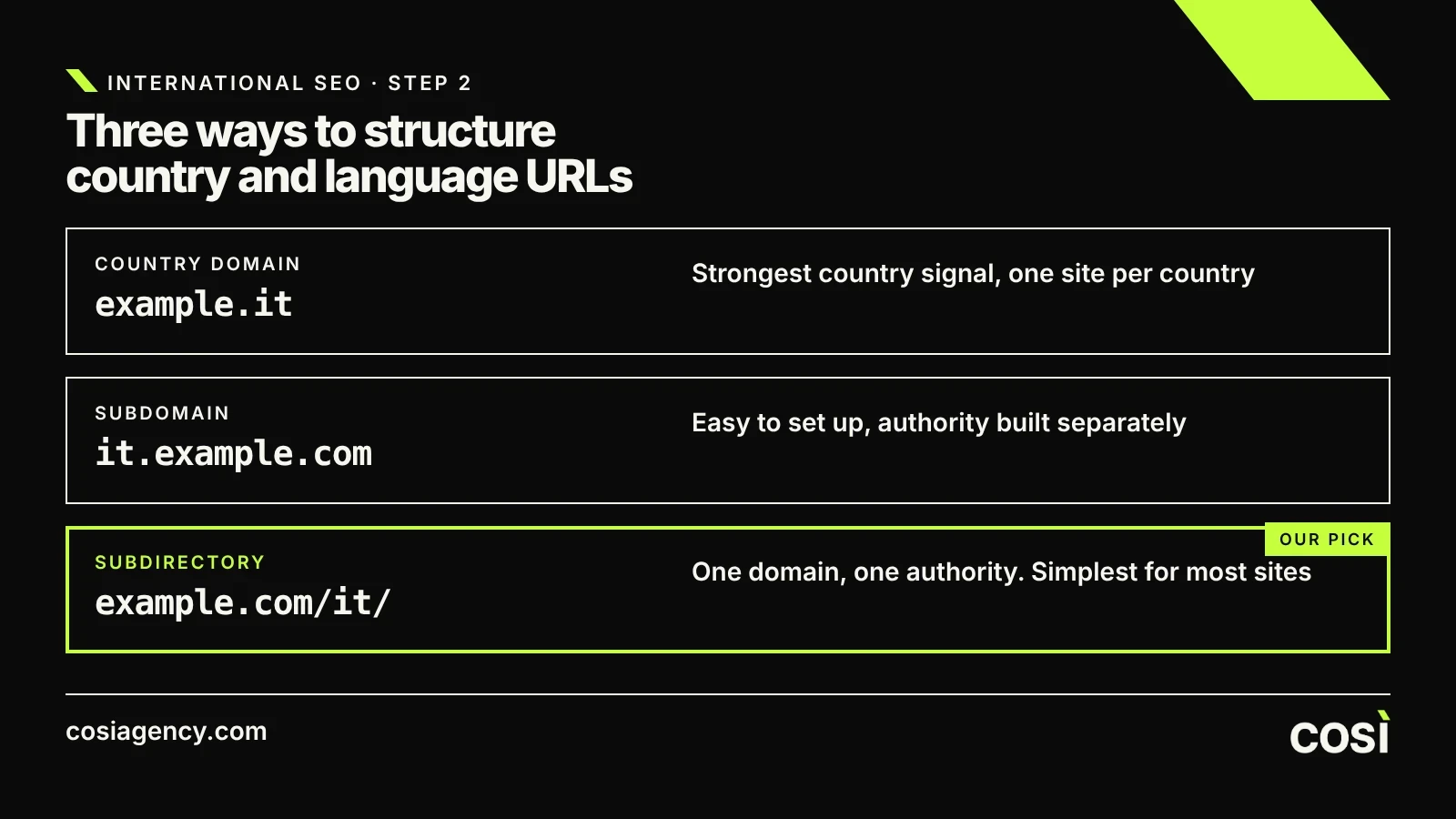
Each language or country version needs its own URLs. You have three options:
| Structure | Example | Strength | Drawback |
|---|---|---|---|
| Country domain (ccTLD) | example.it | Clearest country signal | A separate site to build and promote for each country |
| Subdomain | it.example.com | Easy to set up, can use separate hosting | Can behave like a separate site, so building authority takes more work |
| Subdirectory | example.com/it/ | One domain, authority builds in one place, simple to manage | Weaker country signal than a ccTLD |
For most small and mid-sized companies, subdirectories are the simplest choice. A country domain makes sense when a local brand identity or a legal presence matters more than shared authority. cosi uses subdirectories: /en/ for English, /it/ for Italian, and Turkish at the root.
Step 3: tell Google which version is which
Hreflang annotations tell Google that pages are equivalents in other languages or regions. Every version must list all versions, including itself, and the links must be reciprocal. We explain the rules and give a copy-ready example in our hreflang guide. Do not redirect visitors automatically by IP address or browser language, because Googlebot may never see the other versions. Let people choose with a language switcher.
Step 4: localise, do not just translate
Translation changes the words. Localisation changes the page so that it works in that market:
- Keywords differ by language. The literal translation of your English keyword is often not what people actually search for. Run keyword research in each language.
- Details change. Currency, units, date formats, phone numbers, legal text and examples should fit the country.
- Review the text. Unchecked machine translation reads poorly and can look like low-quality content to search engines. Have a native speaker review every page.
- Translate the whole page. Titles, meta descriptions, headings, image alt text and internal links need the same care as the body text.
Step 5: build local signals
Search engines look for signs that a site belongs in a market. Useful signals include links from sites in that country, local directories and profiles, a local address or phone number where you have one, and local proof such as reviews and case studies. Hosting location matters little today, so using a CDN is fine.
Step 6: measure each market separately
Total traffic hides what is working. In Search Console, filter the performance report by country and by page, and compare clicks, impressions and average position per market. In your analytics tool, compare conversions per language. Set a target for each market before you launch and review it after a few months, because new markets take time to build.
Mistakes that waste months
- Launching many languages at once, with thin or untranslated pages.
- Using hreflang without checking that the links are reciprocal.
- Copying one page into several regional versions without any real difference.
- Redirecting users automatically by location.
- Ignoring local keywords and translating the English ones instead.
- Letting a multilingual plugin slow the site down. In our speed study of 324 agency websites, WordPress sites using WPML averaged 58 on mobile, below the overall average of 61.
- Measuring only the global total.
How we apply this at cosi
Our own site is in Turkish, English and Italian, and each article is published in all three languages and linked with hreflang. For flaneur21, a Turkish and English culture publication, we combined bilingual international SEO, content architecture and UX work, and monthly pageviews grew five times in 12 months. Read the case study.
If you sell abroad, your catalogue and category pages are where international SEO pays off first. See how we work with fashion and textile brands that reach overseas buyers.
Summary
- International SEO is more than translation: markets, URL structure, signals, local content and measurement.
- Start with one or two markets and choose them with data.
- For most sites, subdirectories are the simplest URL structure.
- Use hreflang, and never redirect visitors automatically by location.
- Localise instead of translating, and measure each market separately.
Planning to reach new markets and not sure where to start? We can review your site and help you choose markets, structure and keywords. See our international and multilingual SEO service, or request a free analysis."